
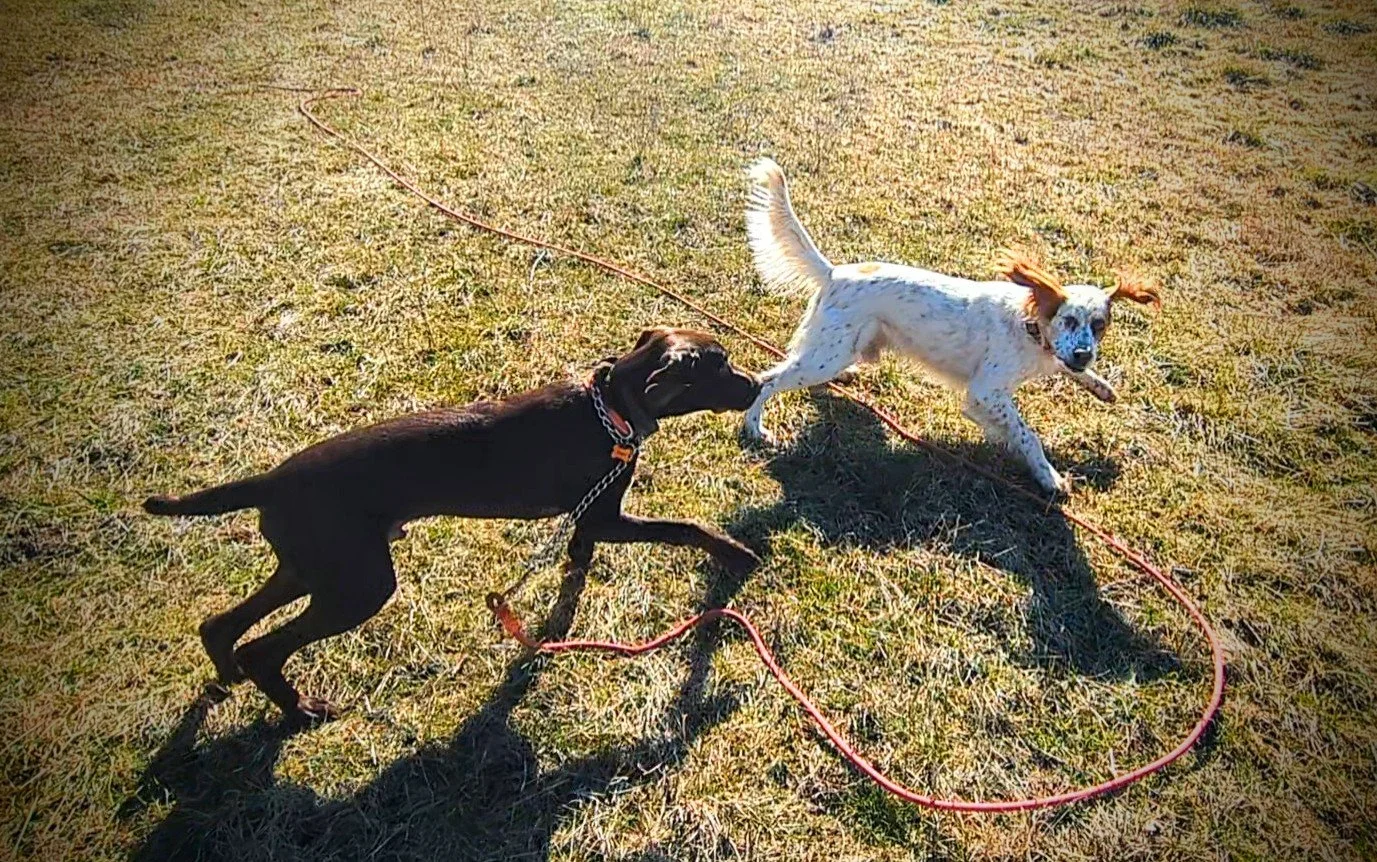
Canine Socialization: Definitions and Tips to Develop a Calmer Dog.
photo by author
Canine Socialization:
Definitions and Tips to Develop a Calmer Dog.
Pointing Dog Journal I Spring 2026
Story by Jack Hutson
“You train dogs; can I ask you a question?” We had pulled-into an east Montana rest-stop as much to stretch and relieve the monotony as anything else. There, we came across an Oregon couple also prospecting eastward in search of upland birds. My son Nathan and I managed our leashed setters as the coastal couple were on their way back from a brief exercise period with a delightful pair of Brittany’s. Understandably, there was a mutual bond that soon developed into a conversation centered around dogs and hunting.
Wanting to get on their way, the wife had begun settling the Britt’s inside the pickup’s canopied enclosure. Sensing this, the gentleman had bid us safe travels and turned to walk away when something compelled him to return. The look on his face displayed the seriousness of the situation. His question involved a long-time friend and his very aggressive male Brittany. The friend’s dog would tear into this couple’s slightly younger dogs at every opportunity – even while hunting! “I don’t want to avoid my friend forever but, as it is, we can’t hunt together,” finished my exasperated new friend.
Of course, without more background info and observation, I could offer very little help. Multiple factors are often involved in matters of canine socialization; making finding a “fix” sometimes quite difficult. Canine psychosocial issues, without obvious injury, can make the diagnoses and subsequent remedy a series of best guesses for most of us. In fact, the term “socialization” itself seems to be a mystery that causes confusion for some.
Socialization vs Acclimation:
Yes, there seems to be some confusion as to what canine socialization actually means. Put simply (and seemly obvious), socialization requires social interaction. Misinterpretation is often displayed when the use of the term is broadened to include environmental interaction. Socialization is not getting your dog familiar with fields and fire hydrants. Often referred to as “boldness” in gun dog training circles, terms such as “familiarization,” or “adaptation” aptly describe a dog accepting – even welcoming - its training surroundings. For the purposes of this article, I will use “acclimation.”
As is generally the case, how the use of the term socialization became so broad is probably a combination of several things. The major culprits are likely folks that have heard (or read) the term and, to project a semblance of knowledge, misapply it about like sowing seeds of wisdom.
Perhaps, another cause can be the allowed misuse by the profession. Trainers or behavioralists may overlook the mistaken usage of the term in an effort to address a separate issue being considered at the time. Without polite correction, the client, student, or interviewer is left with a mistaken definition that is unwittingly spread in various forms.
Proper Definition and Examples:
The term “Socialization” as it relates to canines, its origins, seem to stem from a rooted relational concept that canine and human psychology are similar enough that terms formally used to describe human behavior and psychology spilled-over into canine training and interaction. Humans had experimented on canines for centuries before physiologist Ivan Pavlov’s formal experimental use of canines during his benchmark studies in classic conditioning began. The cross over from physio to psychological observations were profound and have established the basis for what many define as ethical or positive training methodology today.
so·cial·i·za·tion sōSHələˈzāSH(ə)n - noun,
Def: Socialization is the interaction between people that brings about behavioral advancement as it pertains to accepted social norms.
1. The activity of mixing socially with others. Usage example: "socialization with students has helped her communication skills."
2. The process of learning to behave in a way that is acceptable to society. Usage example: “preschool starts the process of socialization."
Referring to the dictionary definition above, what can be decerned from the example usage - "preschool starts the process of socialization"? Is that meant to imply that youngsters are beginning to become familiar with a room filled with tables and chairs? No, of course not! The implication there is that children are learning to deal with other children and teachers.
To paraphrase the basic dictionary definition provided, human socialization is meaningful interaction between people. As the matter involves dogs, it can be defined, “Developing a dog’s behavioral interactions within acceptable norms as it relates to people and other dogs.”
Living Examples:
An example involving dogs might include a visiting dog being introduced to a strange dog in an unfamiliar backyard. The interaction with the new dog is a social experience, to be sure. Dealing with new surroundings in the yard is a form of acclimation or adaptation. This is an important distinction. Basically, if you realize the separation, you understand the stress differential the subject dog is experiencing and can deal with the issues separately and appropriately.
Similarly, another life example might be a case involving a female and her litter. Newly introduced to a nursery box, they will make important headway in the acceptance of their new surroundings of enclosing walls and a base of wood shavings. While learning to accept their enclosure – its echoing sounds, the compressing feel and scent of wood shavings - puppies are developing on-going socialization processes and behaviors amongst themselves, their mother, and human caretaker(s).
Proper Timing:
The importance of social interaction builds as puppies develop; the eighth week being widely recognized as the most critical period of early socialization. Optimally, pups should have multiple (positive) interactions with people and other dogs during the first fourteen to sixteen-weeks of life. Of course, along with social interaction, there should be efforts to desensitize pups to environmental stress and sensual experiences (noise, scents, textures, motion, etc.), as well.
Like most serious behavioral issues, preventative measures are, by far, the most effective. Early training and introduction while dogs are young will likely prevent many social issues. A pup that is universally welcomed can often trace their beginnings back to their positive interactions among littermates, other dogs, and the people they encountered. If symptoms of fright or aggression (often displayed as one) toward dogs or humans begin to manifest, training may have to take a backseat to identifying the triggering situation(s) and applying behavioral efforts that thwart advancing issues.
Suggested Techniques:
There are several ways to develop socially confident dogs. In urban environs, young dogs are often taken to dog parks and walks through variously populated surroundings. Keep your pup leashed (at first, anyway) and remove them from annoying (barking or aggressive) dog behavior. All to prevent the pup from learning bad behavior or becoming overwhelmed and intimidated by the conditions. (In these situations, I would suggest making sure that your pup is up-to-date on its vaccines because you cannot control the care the other dogs are receiving.)
One concern may be the number of dogs being introduced to your pup at one time. By going to dog parks during off-hours, you can avoid the overstimulation caused by an overwhelming number of dogs. As for human interaction, be conscience of ruff-handling - ear, hair, & tail pulling – behavior from young children. Of course, avoid contentious situations brought on by items such as another dog’s personal space, toys, food, etc.
Another technique is to involve a young dog in training sessions or classes. There your dog and you can work on socialization while training specific skills. A very rare situation that effectively offers multiple learning opportunities. All the while being watchful of how the young dog reacts to the environment and the introduction to other dogs. You may find it useful to sit on the sidelines and allow the pup or young dog to get comfortable with the surroundings before involvement with multiple dogs.
I like to introduce pups to other dogs in larger venues such as training fields. If the pup is familiar with the area and has had so much fun being distracted by the many sounds, sights, and smells they will tend to enjoy the addition of a dog buddy to share it with. The young pup’s perception of how other dogs are reacting to environmental stimuli can be considered part of a social learning experience.
Of course, let’s not forget that, your daily involvement with your pup is the most critical social interaction of all. Important human/canine social interaction will include feeding and exercise, of course. All interrelations should include fair and consistent handling that is predictable and develops trust. A young dog that is comfortable with its handler will likely grow to be well-adjusted and not fearful.
Summary:
Though extremely important, a dog becoming completely comfortable with vehicle travel and various environmental conditions is not developing social behaviors. To accomplish that, there must be meaningful interaction between other canines (and humans). These two aspects of life (acclimation and socialization) differ enough that they are often developed separately to some extent.
It may seem like picking nits but, by developing and using proper definitions, we can communicate more clearly and apply what we learn more effectively. All on our way to becoming appropriately socialized.